 Ryan Higgins
Brand Campaign · Product Design
Call the Cup
A CEO brief. A bracket mechanic that turned Chatham's hedging identity into gameplay. Three weeks from winning concept to live on cf.com.
Overview
The Work
The CEO had the idea. Chatham's Global Client Summit overlapped with the World Cup — clients at matches, events around the tournament. A bracket game on cf.com tied the whole moment together.
We had just relaunched cf.com with a new brand and a first look at Onyx. This was the chance to put that brand in motion — in front of clients who were physically at the tournament, prospects following along, and the broader Chatham community. The stakes for the new brand were real, not theoretical. It needed to move fast and look right.
Challenge
The Problem
The UX team got the brief and the constraints: a fixed deadline set by a bracket game — June 10, when the group stage kicked off and picks had to be locked. We ran it as a jam. Each designer took a few timeboxed hours, built a concept, and recorded a video demo.
Leadership chose mine. It won on motion — the Veo hero in the demo made the mechanic feel real before a line of code was written.
A fixed date. A new brand that needed to earn its first moment. One concept to carry it all the way to production.
Approach
How I Worked
The jam format was the process. Timeboxed exploration, recorded demos, a leadership review. What followed was less linear — a fast ramp from winning concept to working frontend, with a production engineer handoff baked in from the start.
Winning the jam
What sealed it wasn't the mechanic — it was how the mechanic felt when you saw it move. I built the concept in a few hours: three distinct pick types, a Veo-generated hero, and a demo that showed brand in motion, not static. I knew that's how you sell a new design system to leadership — show it alive. Leadership approved the same day.
Designing the Heart/Head/Hedge mechanic
The core insight was brand alignment. Chatham is the global leader in hedging consulting and execution. Building a 'Hedge' pick into the bracket turned our identity into the game mechanic — not marketing copy laid over a feature, but the feature itself. Heart, Head, Hedge also gave every entry a personality: how optimistic, how much chalk, how strategic.
Generating the hero with Veo
I generated the hero video in Google Veo, pulling from Chatham's brand motif — the aperture and lighting effects that reinforce the Illuminate pillar. A few generations in, the motion matched the brand language exactly: no stock footage, no licensing, no art direction notes. It made the page feel alive, and it was the first thing leadership pointed to in the review.
AI-native, but deliberate
Claude Code and Cursor drove the early build. When the UI needed real precision — keeping the bracket component's system compliance intact while changing its layout — I switched to the Figma MCP: surgical changes in Figma, fed back to Claude to implement. Prompting alone would have regenerated the whole component and broken the surrounding system. Knowing the handoff point between AI speed and deterministic tooling is a judgment call, not a workflow setting. That distinction is what let the design hold through the engineering integration.
Working with Jacalyn on the system
Jacalyn is a senior product designer on the design systems team — a genuinely excellent systems thinker — and a former student of mine. We treated this sprint as a design system stress test. Where the bracket UI pushed against what Luma had, we defined new patterns: leaderboard state variants, pick-type badge treatments, locked-state affordances. Those patterns fed back into Luma and will outlast the campaign.
Handing off to engineering
Inside about a week, agentic coding got the site to a real state. I worked in the front-end repo, creating branches and PRs in GitHub, building toward a clean handoff. Engineering reused the vast majority of the code to wire up live scores, news, and match details. The design held up through all of it, which kept the team fast.
Solution
What We Built
The bracket launched with Heart, Head, and Hedge picks intact. Scope calls came fast — the archetype system and a lighter daily-picks mode came out against the fixed date. The core mechanic stayed in.
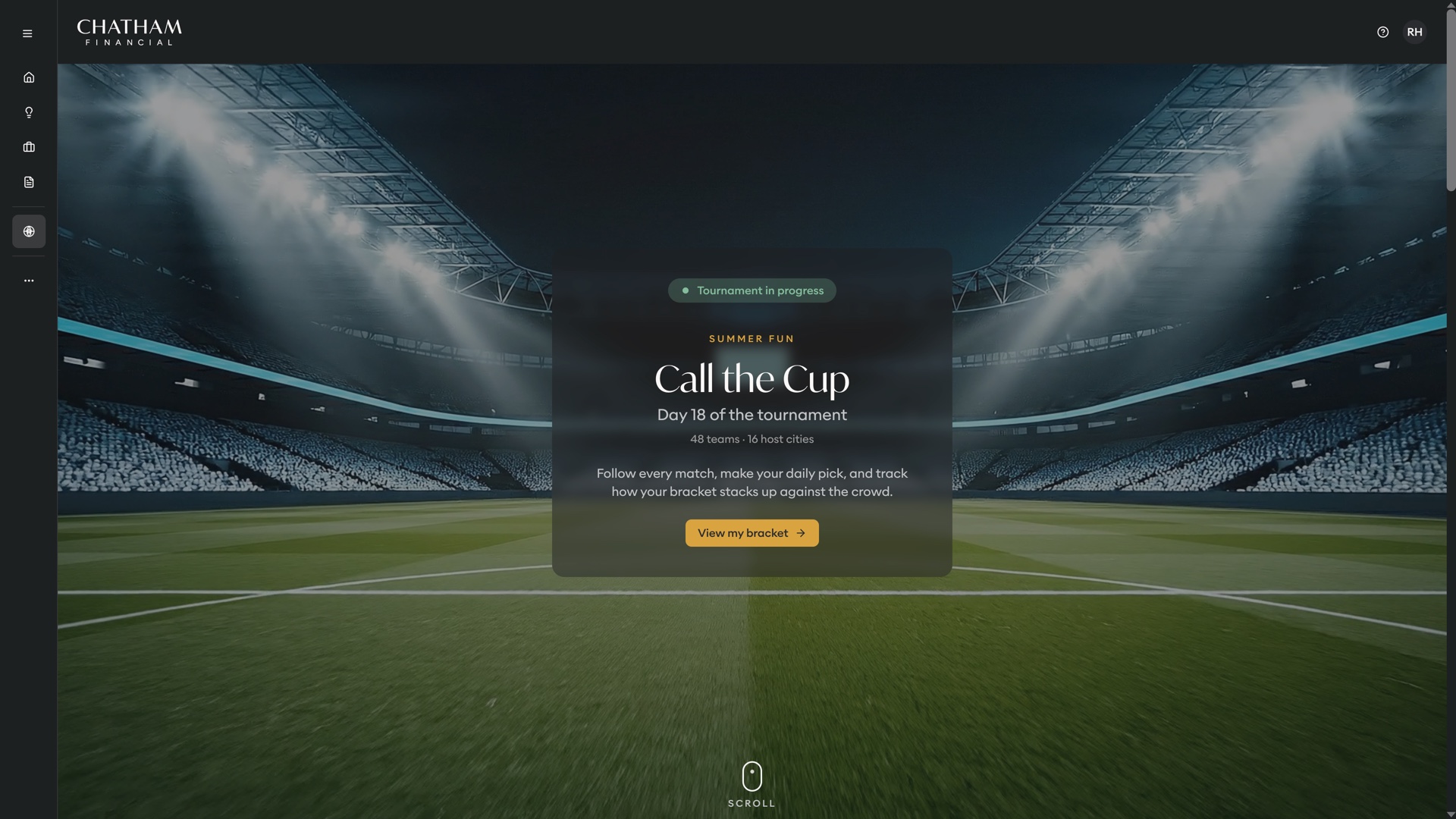
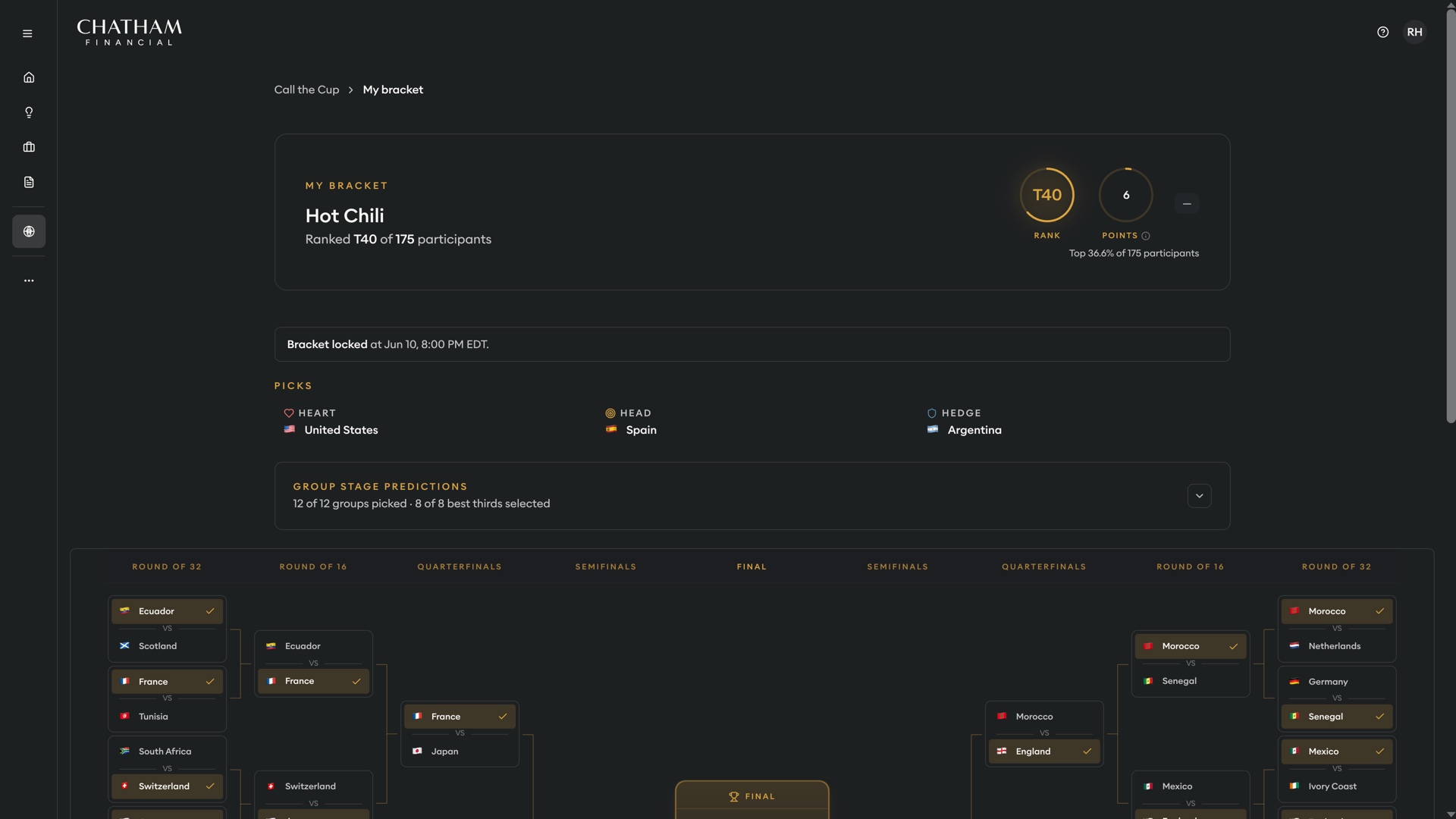
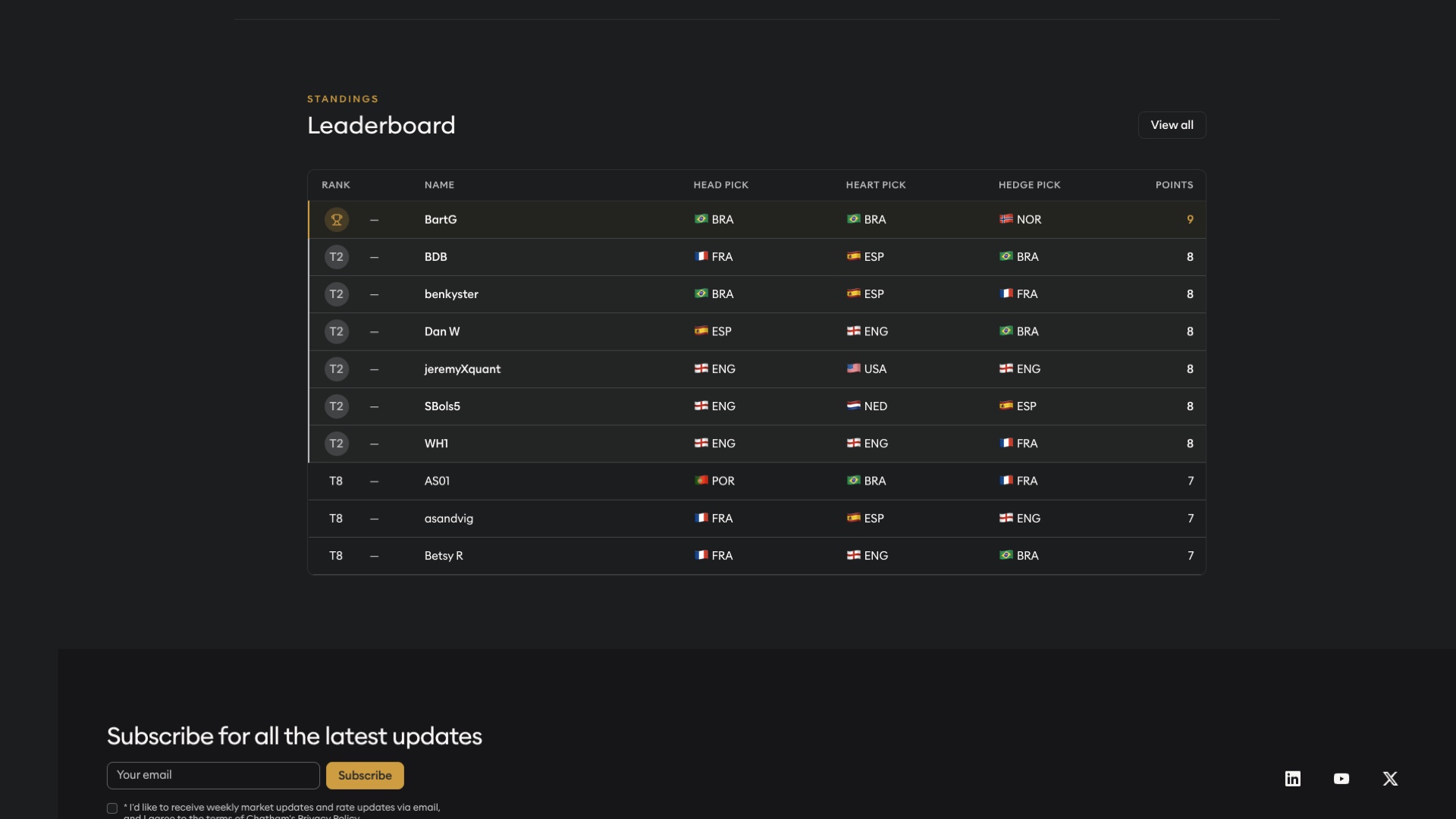
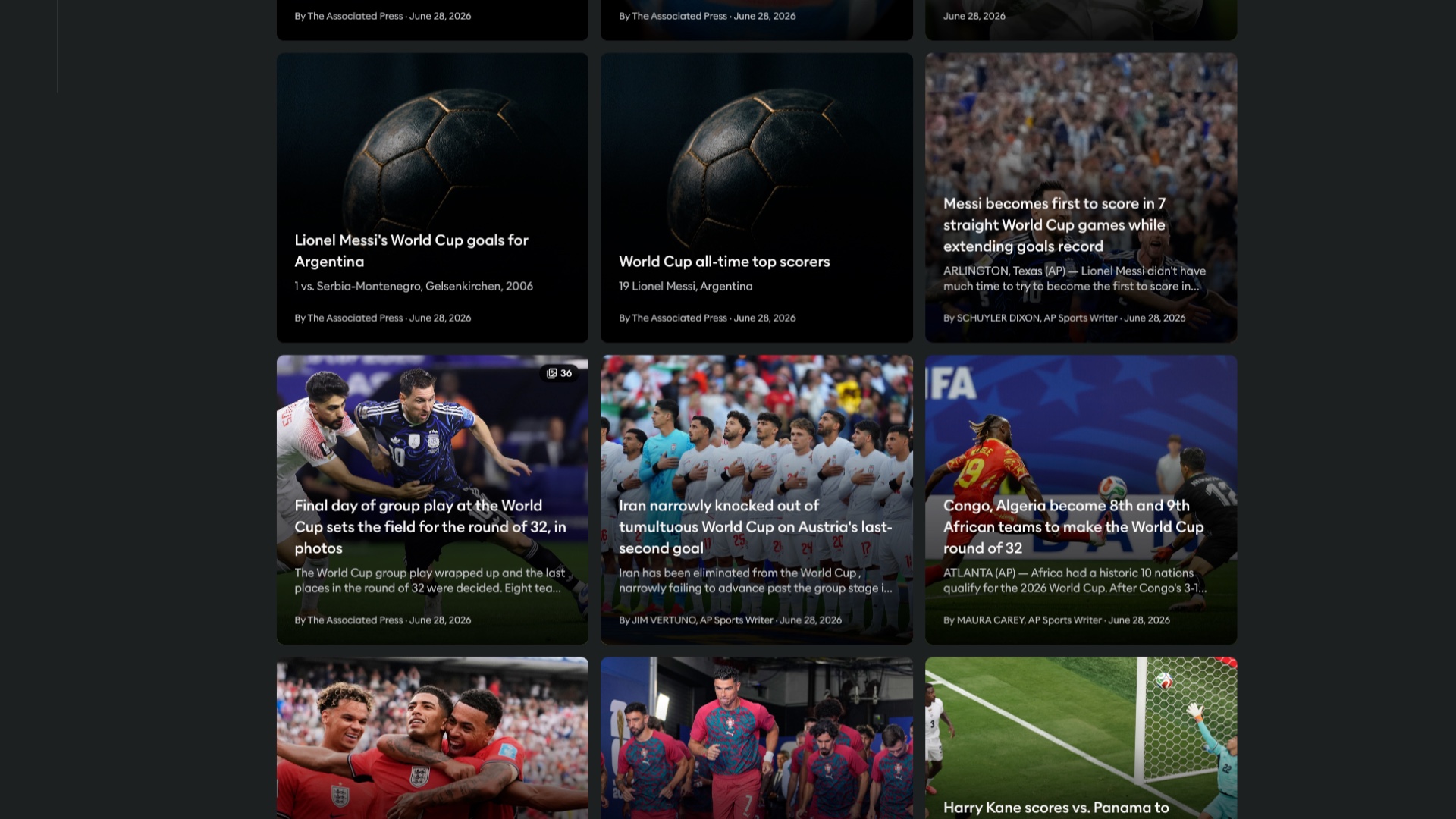
The bracket — Heart, Head, and Hedge picks turn our hedging identity into the mechanic
Heart, Head, Hedge picks
Every participant made three picks: who they want to win, who they expect to win, and their hedge. The mechanic turned brand identity into gameplay. It also gave the leaderboard personality — you could compare your strategy type against the crowd, not just your score.
Veo hero video
A looping hero generated from Chatham's brand aperture and motion language — no stock footage, no licensing, no production timeline. The page felt alive from first scroll, which is what made the jam demo land.
Live scores, news, and match context
Engineering wired live match data, news, and fixture details into the product design scaffold. The pages held up through the integration, which meant no redesign mid-sprint — just data flowing into structure that was already right.
Appcues launch campaign
I designed and built Appcues banners and modals announcing the bracket to enterprise platform users and to free and pro users on cf.com. The campaign ramped into the group-stage kickoff and drove the initial wave of bracket entries.
Results
What Changed
175 brackets filled. Thousands of unique sessions. Meaningful new signups — exact figures are confidential but the engagement was strong across new and existing client users and the broader Chatham community.
New interface patterns from the build were adopted back into Luma — leaderboard states, pick-type treatments, locked-bracket affordances. The work outlasts the campaign. CEO sponsorship and org-wide visibility made this the internal reference point for what AI-native design and build can deliver in a fixed window: a functioning product, a new brand debut, and a richer design system, all in three weeks.
Reflection
What I Learned
If I could go back, I'd spend more time iterating on the Veo hero video — I got something that worked, but more passes would have pushed it further. The motion was the thing that won the room and it deserved more investment.
The two features we cut against the deadline — the archetype system and the daily picks mode — are the ones that still feel unfinished. Archetypes gave users a personality based on how they picked; daily picks was a lighter entry point for people who didn't have time to fill a full bracket or missed the June 10 lock. Both would have deepened engagement meaningfully. The deadline was right to hold, but those are real features that deserved to ship.
A concept wins on feel, not explanation
The mechanic was clever, but what got leadership's attention was the motion. A looping hero that makes the page feel alive is not something you can describe in a jam debrief — you have to show it. The Veo video made the concept real in a way a static mockup couldn't. In a competitive jam, the demo that moves wins.
Brand alignment beats brand decoration
Putting 'Hedge' in a bracket game isn't a tagline decision — it's a product decision. When your brand identity becomes the mechanic, not a layer on top of the mechanic, users feel the difference. It's the difference between a company that sponsors a game and a company that designed one.
AI is fastest when you know where to stop prompting
Agentic coding for speed; Figma MCP for precision. The distinction matters because prompting regenerates — it doesn't refine. Surgical component changes, system compliance, engineering trust: those require deterministic tooling. Knowing the handoff point isn't a workflow setting. It's a judgment call, and it's the actual skill.
Ship campaigns that improve the system
Working with Jacalyn meant the work wasn't just good for the product — it was good for the system. New patterns found their way back into Luma. That's the multiplier: a campaign that ships in three weeks but improves every product built after it.
A fixed date is a feature, not a constraint
Bracket lock on June 10 was non-negotiable. That clarity made scope calls easy. The archetype system and daily-picks mode came out without debate because everyone knew what the ceiling was. Fewer features shipped perfectly beats more features shipped fragile.